M9
Vistek is pleased to announce the unveiling of the new Leica M9. See it for the first time in Canada at Vistek Toronto.!
Please join us on Friday, September 11th at 11:00 a.m. to see the M9 first-hand along with the launch of S2.
For more information click here.
LEICA M9 - the first ever rangefinder camera with a full-frame 24 x 36 mm sensor.
The history of 35-mm photography began almost 100 years ago with the legendary Ur-Leica. Today, it is the Leica M9, a landmark camera that carries the proud heritage of Leica M cameras into the digital age. The Leica M9 is the world’s first digital system camera of its size to be built with a full-frame sensor – a CCD sensor developed specifi cally for the M9 – that is capable of perfectly capturing the full 35-mm format (24 × 36 mm) in ultra-high resolution. The new M9 – in the familiar, classic, and timeless M design, represents the quintessence of its predecessors based on the consummate technological level of our time. It is the perfect contemporary tool for those who set the highest standards in image quality and are committed to creating images of enduring value.
PRE-ORDER YOURS NOW!
Leica M9-P Black Body
In Stock - ships in 1 to 2 business days
Lease It
Webcode: 257776
Mfr item: 10703
$8,499.00
SAVE $300.00
Webcode: 253920
$11,199.00
SAVE $500.00
Webcode: 245988
Mfr item: 10705
$6,999.00
SAVE $500.00
Leica M9 Black Body
In Stock - ships in 1 to 2 business days
Lease It
Webcode: 245987
Mfr item: 10704
$6,999.00
SAVE $500.00
Uncompromising Image Quality
With its extremely high-resolution image sensor in full-frame 35-mm format and cutting-edge imaging-processing system, the Leica M9 is uncompromisingly dedicated to capturing images of the very highest quality. The photographer may choose between image storage in JPEG format for fast processing, or as raw data in DNG format that supports a multitude of post-processing otpions. Alternatively, both formats may be stored simultaneously. In the DNG format, photographers may also choose between a compressed, but faster and greater space-saving option, or an uncompressed version that preserves maximum image quality.
Compatibility as a matter of principle
Of course the Leica M9 offers photographers access to the complete Leica M system lenses, long acclaimed by experts and users as the best in the world. Its development began n 1954, and the M-System has been continually advanced and improved ever since. The high-resolution, full-format image sensor of the M9 fully exploits the performance of legendary Leica lenses from corner to corner.
It is hardly unsual that a Leica, once owned, becomes a lifelong companion. This also applies to the digital M9: Its closed, full-metal housing, crafted from a high-strength magnesium alloy, and its top deck and bottom plate machined from large blocks of brass, provide perfect protection for its precious inner mechanisms. The digital components and shutter assembly of the M9 are similarly constructed with endurance in mind. Free firmware updates ensure that the camera benefits from the latest technology. In short: The Leica M9 is an investment for a lifetime.
Silence
Discretion and unobtrusiveness are particular strengths of the M-system. In operation, the shutter of the M9 is as quiet as a whisper. An extremely low noise level with cocking the shutter is ensured by a sophisticated motor and geared system. In discreet mode, the shutter is only cocked after the photographer's finger is lifted from the shutter release button when, for instance, the camera is concealed under a jacket. When shooting handheld at long exposure times, or whenever extreme steadiness is essential, slight pressure on the shutter release button in "soft-release" mode is sufficient to trigger the camera. In addition to these advantages, the fact that the combination of camera and lens is significantly more compact than any other full-frame camera system contributes to the fact that M photographers are frequently unnoticed and often simply blend into the background.
Speed
The Leica M9 adapts to its intended uses in a seamlessly flexible manner. Its sensitivity ranges from ISO 80 for wide-open apertures on bright days to ISO 2500 for low-light image capture. Very low noise levels and finely detailed images are achieved throughout the sensitivity range, even at the highest ISO settings. Very low image noise characteristics, an extremely bright viewfinder/rangefinder, low-vibration shutter and the availability of super fast lenses make the M9 the perfect camera for available-light photography.
Complete control of all picture parameters
The Leica M9 aids photographers with automatic functions whenever they're required, but it never dictates how to shoot or interferes with the picture-taking process. Depending on the light level, the automatic ISO shift function increases the sensitivity of the camera as soon as the shutter speed falls below a hand-holdable value. At the same time, it also limits the shift to a maximum value determined by the photographer. This means that correct exposure without camera shake and the lowest possible sensitivity is always available to guarantee the best possible image quality in all situations. In addition, the M9 also offers automatic exposure bracketing with a user-selectable number of shots and exposure increments. The fucntion ensures that even high-contrast subjects are perfectly captured.
Full frame 24x36mm without any compromises
The CCD image sensor in the M9 was specifically designed and developed for this camera and offers full 35-mm film format without any compromises. All M lenses mounted on the M9 offer the same exact angle of view they had when shooting film material and therefore can now be used to an optimum effect. In other words, all the outstanding characteristics of Leica M lenses are now fully maintained for digital photography as well. In short, the high resolution and superior image quality of the M9 has the ability to fully exploit the enormous potential of the M lenses.
Optimized sensor
In the case of the M9, it wasn't a matter of modifying the lenses to match the image sensor, but rather the other way around. Leica's dedication to further developing the image sensor has resulted in a component perfectly matched to its intended role in the very compact M-System as well as to the performance of the M lenses. The special layout of the micro lenses found in the M0 sensor makes it tolerant of oblique light rays impinging on its surface, thus assuring uniform exposure and extreme sharpness from corner to corner of every image. As a result, future Leica M lenses can be designed and optimized with uncompromising dedication to the achievement of the highest performance and compact construction. A newly developed sensor filter ensures the suppression of undesirable infrared light. The conscious decision to do without a moire filter, a cause of image deterioration through loss of resolution, ensure maximum resolution of the fine detail. The optimized signal-noise ratio of the CCD image sensor reduces the need for digital post-processing and ensure that M9 images possess an unrivaled and natural visual impact.
Intuitive controls
The key control element of the M9 is an intuitive four-way switch and dial combination used in conjunction with the 2.5-inch LCD monitor on the back. To set the ISO sensitivity, simply maintain light pressure on the ISO button while simultaneously turning the dial to select the required setting. All other functions important to everyday situations are quickly and easily accessible by pressing the set button: white balance, image-data compression, resolution, exposure correction, exposure bracketing, and programmable user profiles. The user profiles can be programmed with any combiantion of camera and shooting settings, stored under an assigned name, and accessed quickly whenever required for a particular situation. An additional pre-defined snapshot profile is also available. In snapshot mode, the M9 automatically sets as many settings as possible, thus providing a valuable aid to spontaneious and discreet photography. All other functions - from automatic lens recognition via six-bit lensmount coding and selection of the required colour space to cleaning of the sensor - are easily found int he clearly arranged main camera menu.
All information at the push of a button
Pressing the "info" button in shooting mode displays the precise charge level of the batter, the remaining number of frames on the installed memory card, and the most important basic shooting settings, for example the shutter speed, on the camera's brilliant 2.5-inch LCD monitor. In image-view mode, users can switch between an image-only view (with a zoom option up to single pixel level) or access other information by simply turning the dial. The available data includes information on the ISO sensitivity setting and shutter speed in use, plus a precise histogram display.
Lens with six-bit coding
The extremely efficient image sensor of the M9 demands a particularily high spatial resolution to deliver all the image quality delivered by the latest M lenses. Their excellent correction for optical aberrations and high resolution makes them a perfect match for the awesome digital capture capabilities of the M9. The current M lenses are supplied with a six-bit code on the mount that is scanned optically by the M9. On the basis of this coded information, the M9 can compensate for any negligible, system-inherent vignetting effects. In addition, the lens type is recorded in the EXIF data of the image files and, when using the latest flash units like the Leica SF 58, the camera automatically adjusts the flash head to match the focal length of the lens in use.
Increased sensitivity through micro-lens technology
Micro lenses are employed to ensure that more light reaches each individual pixel of the M9 sensor. As a consequence of the extremely compact design of the Leica M cameras, rays of incoming light at the edges of the image field impinge obliquely on the sensor and would therefore not be captured by asensor employing conventional micro lenses. As a result, the image sensor of the M9 employs advanced and meticulously designed micro lenses which have a low refractive index. In addition, the micro lenses at the edges of the sensor are laterally displaced towards the image center to match the characteristics of M lenses precisely. This optmized micro-design, based on many years of precision optical engineering experience, captures and concentrates even the most oblique rays on the sensor and reliably delivers full image brightness across the image field without any fall-off at the edges and corners of the images. This ensures that all existing Leica M lenses maintain their full performance when used for digital photography.
Suitable for flash photography
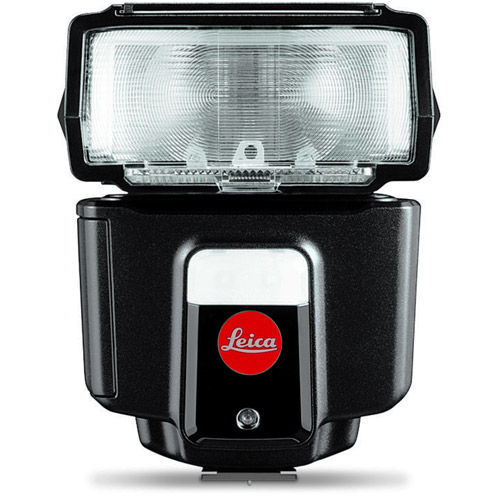
The M9 is also eminently suitable for flash photography. With either the Leica SF 24D, a compact flash unit ideally matched to the M9, the high powered Leica SF 58, or other brands' flash units with SCA 3502 adapters, M-TTL flash technology enables precise creative control via flash and mixed lighting effects. Prior to the actual exposure, the units emit a measuring flash that is metered through the lens. The flash power is then precisely calculated and set taking into consideration the ambient, natural light level. Thanks to this precise balancing of flash illumination and existing light, the mood of the scene is maintained and the picture looks completely natural. In combination with the aperture priority exposure mode, the auto-slow sync function ensures a subtle lightening of the subject that enables the longest shutter speeds to be set manually or, when using six-bit coded lenses, automatically based on the 1/focal length rule of thumb.
Workflow
Included with the LEICA M9, is a license for Adobe Photoshop Lightroom, a professional digital workflow solution available for both Mac OS X and Microsoft Windows operating systems. The software is a free download for LEICA M9 customers, to guarantee that the most current version is always available.